(479) 304-0400
Red tractor with a front loader on freshly mulched ground, a mound of wood chips and young pines around the clearing

Forestry mulching and forestry mowing in Arkansas

Mark's Arkansas Land Clearing Service does forestry mulching statewide from three Google listings, rated 5.0 on Google. The mulcher grinds brush, cedars, and small trees where they stand.

A short recording answers first. Press 1 and you're put through.

Ask any forestry mulching company these six questions

We read the 1-to-3-star Google reviews of 88 Arkansas clearing and tree companies, and 172 of them were about the work itself. Complaints about mulched brush growing back turn up in landowner forums instead. Each answer below is a promise the person running your job carries out.

  1. 01

    What will the mulcher leave on my land?

    29 of 172 reviews: the crew left the mess behind

    Your written quote says what happens to every bit of cut material: mulched in place, piled, or hauled away.

  2. 02

    How low are the stumps, and how thick is the mulch?

    11 of 172 reviews: stumps left that the owner expected gone

    Your quote says how the stumps will be left (ground level, below grade, or removed) and about how thick the mulch will be. We check it with you at the walkthrough.

  3. 03

    Will you mark the trees I want to keep?

    17 of 172 reviews: the work wasn't what was agreed

    Before the machine starts, we walk and flag the boundaries and anything you want saved, or send you photos of them.

  4. 04

    Will the brush grow back?

    Landowner forums, outside the 172: brush that sprouted back after mulching

    Before we quote, we tell you what the ground will look like the day we leave and what it will need afterwards to keep the brush from coming back.

  5. 05

    Who calls me back?

    61 of 172 reviews: the crew stopped answering

    Every call or text gets a call back the same working day, from the person running your job.

  6. 06

    Can the price change after I say yes?

    12 of 172 reviews: the price changed with nothing in writing

    You get a written quote before any work. It lists every charge, travel included. The price changes only if you approve the change in writing first.

Quick answers about forestry mulching

What Arkansas landowners ask Google before they hire a mulcher. Each answer starts with the answer.

What are the downsides of forestry mulching?

Mulched ground is covered in wood mulch, not bare dirt ready for seed, and the roots stay in the soil. K-State Research and Extension notes that hedge and honey locust sprout back from below ground. Before we quote, Mark's Arkansas Land Clearing Service tells you what the ground will look like the day we leave.

Will grass grow after forestry mulching?

Yes. Grass grows up through the mulch, and the ground can then be kept open by mowing. Mark's Arkansas Land Clearing Service writes on your quote about how thick the mulch will be, and we check it with you at the walkthrough.

What is the difference between land clearing and forestry mulching?

Forestry mulching grinds brush and small trees where they stand and leaves the mulch on the soil. Land clearing takes trees, brush, and stumps off and leaves open ground, with the cut material mulched, piled, or hauled away. Mark's Arkansas Land Clearing Service does both, and your written quote lists every charge.

What to do with land after forestry mulching?

Keep it mowed and deal with sprouts early. Eastern redcedar cut below its lowest green branch won't sprout back, K-State Research and Extension says, while hardwoods such as honey locust can. Before we quote, Mark's Arkansas Land Clearing Service tells you what the ground will need afterwards to keep the brush from coming back.

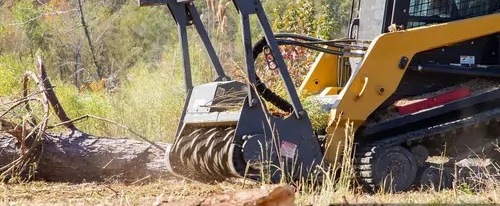
Tracked skid steer with a forestry mulcher head grinding brush among pines, dust in the air
Frame 02Forestry mulcherArkansas

Over 20 years of forest clearing in Arkansas

Mark's Arkansas Land Clearing Service is fully licensed and insured. We carry liability insurance and send the certificate on request.

We have the equipment for any land clearing or earth-moving job. The photos on this page are our own: mulcher heads on tracked loaders, and a mulching head on an excavator for steep ground. The estimate is free, and our lines are open 24/7.

Crews work statewide from three Google listings: Hindsville, Greenbrier, and Hot Springs. The mulcher comes to your land.

How a forestry mulching job goes, from your call to the walkthrough

Six steps, in order, and what you see at each one.

  1. 01

    You hear back the same day

    Every call or text gets a call back the same working day, from the person running your job. If we can't take your job, we say so on the first call.

  2. 02

    We walk the brush with you

    You show us what you want mulched and what stays standing. That walk is what your quote is written from.

  3. 03

    Your quote, in writing

    You get a written quote before any work. It lists every charge, travel included. Your quote comes with a start week.

  4. 04

    Two calls before the mulcher

    We call the day before, and again when the crew pulls in.

  5. 05

    The mulching

    If the ground is too wet to work without rutting, we tell you and reschedule. Any ruts we make are smoothed before we leave.

  6. 06

    Walkthrough, then payment

    We walk the site with you before we call the job done. Final payment is due after the walkthrough. Every payment gets a receipt.

Brush mulching, wood clearing, and scrub clearing

Some call it forestry mowing, some call it forest clearing or brush mulching. These are the five kinds of Arkansas ground we mulch.

  • Two tracked loaders, one with a mulcher head, parked in thinned pine woods

    Underbrush beneath standing timber

    Wood clearing that grinds the brush and saplings under pines or hardwoods and leaves the timber standing. On hunting land, the same work opens shooting lanes and trails.

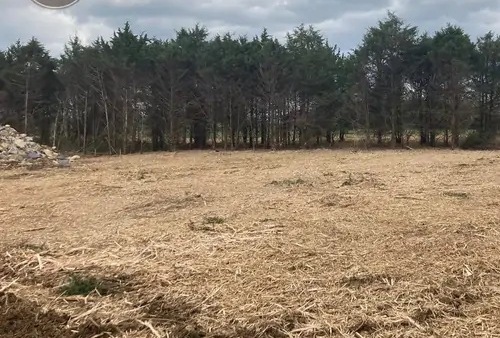
  • Open field under fresh wood mulch after clearing, a line of cedars behind it

    Pasture the cedars took over

    Scrub clearing on grazing ground, with the cedars and brush ground into mulch where they stood. For cedar thickets and fence rows on their own, see brush removal.

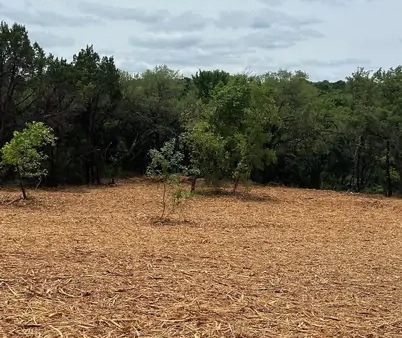
  • Cleared lot covered in wood mulch, a few young trees kept, hardwoods at the edge

    Wooded lots, with the trees you flag

    A lot opened up for a house or a cabin, with the trees you choose left standing. A building pad then needs site prep and dirt work.

  • Skid steer with a brush cutter head working through brush beside downed timber

    Fence rows, trails, and field edges

    Brush cut back along fence rows, trails, and field edges so a truck or a mower gets through.

  • Red and white excavator with a mulching head clearing brush on a steep hillside among tall pines

    Steep, brushy hillsides

    Brush on slopes mulched with a mulching head on an excavator, as in this photo, with the pines you want kept left standing.

Forestry mulching, land clearing, or brush removal

Each one leaves your land looking different. Here's what each takes off and what it leaves behind. Our guide to forestry mulching, land clearing, and brush hogging walks through choosing one.

Forestry mulching

Takes off
Brush, cedars, and small trees, ground up where they stand
Leaves behind
A layer of wood mulch on soil that stays in place
Stumps
Cut to the height your quote names, with the roots left in the soil
Fits
Opening up woods, brushy pasture, and lots when nothing needs hauling off

Land clearing

Takes off
Trees, brush, and stumps
Leaves behind
Open ground. Cut material is mulched in place, piled, or hauled away, as your quote says.
Stumps
Ground level, below grade, or removed, written on your quote
Fits
A lot to build on, pasture, a road, or a pad
Land clearing

Brush removal

Takes off
Cedar thickets, fence-row growth, and underbrush
Leaves behind
The trees you want, with the brush gone from around them
Stumps
Written on your quote
Fits
Fence lines, pasture edges, and yards where the big trees stay
Brush removal

What mulched ground looks like the day we leave

Forestry mulching leaves a layer of ground wood over soil that stays in place, not bare dirt ready for seed. Three things decide how your ground looks.

Drawn cross-section of mulched woods: two flagged trees kept, a stump cut low with its roots left in the soil, and a layer of mulch over the ground 1 2 3
  1. 1Trees you keepFlagged with you before the mulcher starts, and left standing.
  2. 2Stumps and rootsThe mulcher grinds what stands above ground. The roots stay in the soil, under the mulch.
  3. 3Mulch layerGround wood left on the soil holds it against erosion as it breaks down.
If something gets damaged

If we damage anything (a fence, a gate, a line, a culvert), we tell you before we leave that day, and the fix goes in writing.

If we have to leave

If we have to leave before the job is finished, you get the return date before the crew leaves.

5.0on Google

What landowners say about our mulching

Two of our five-star Google reviews are about mulching jobs, one around Conway and one near Fayetteville.

We had hired them to do some forestry mulching around Conway. They did a superb job and the crew completed the job on time. Thank you!

Rashel Reece Liu, Google review
  • Mark and his team are outstanding! They were quick to get back with us, and did an excellent job. We had them clear some land near Fayetteville by mulching. We are so happy with the job!

    Noela May Tiansay
  • A great job they did on my farm.

    Erin Mitchell

Arkansas rules that can touch a mulching job

On the first visit we tell you which Arkansas rules may touch your job (burn bans, the 1-acre stormwater permit, septic permits) and who handles each.

  1. Stormwater

    The Arkansas Division of Environmental Quality's construction stormwater permit, ARR150000, covers construction that disturbs 1 acre or more. Sites of 1 to under 5 acres are covered automatically and keep a small-site stormwater plan before work starts. At 5 acres or more, a Notice of Intent is filed with the Division.Source: Arkansas DEQ, ARR150000 fact sheet, permit effective November 1, 2026
  2. Wetlands

    Section 404 of the federal Clean Water Act regulates putting dredged or fill material into waters of the United States, wetlands included. The U.S. Army Corps of Engineers makes the permit decisions, and certain farming and forestry work is exempt. Low, wet ground gets a closer look before a mulcher goes in.Source: U.S. EPA, Permit Program under CWA Section 404
  3. Burn bans

    Mulch stays on the ground, so most mulching jobs leave no brush piles. Where your quote does leave piles and you plan an open fire for them, check the county first. The Forestry Division's Fire Danger and Burn Ban Map shows the counties under a ban.Source: Arkansas Department of Agriculture, Forestry Division

Forestry mulching near you, region by region

Pick your region to see its towns and the Google listing nearest your land. Every line reaches the same crew.

Northwest Arkansas

Benton, Washington, Madison, and Carroll counties

Central Arkansas

Pulaski, Faulkner, Saline, Lonoke, Perry, Conway, and Grant counties

Arkansas River Valley

Crawford, Sebastian, Franklin, Logan, Johnson, Scott, Pope, and Yell counties

Ozarks and North Central

Boone, Marion, Newton, Searcy, Baxter, Stone, Izard, Fulton, Sharp, Van Buren, and Cleburne counties

Hot Springs and the Ouachitas

Garland, Montgomery, Hot Spring, Clark, Pike, and Polk counties

Northeast Arkansas

Randolph, Lawrence, Clay, Greene, Craighead, Mississippi, and Poinsett counties

White River Valley

Independence, Jackson, White, and Woodruff counties

Arkansas Delta

Crittenden, Cross, St. Francis, Lee, Phillips, Monroe, Prairie, and Arkansas counties

Southwest Arkansas

Miller, Hempstead, Little River, Sevier, Howard, Lafayette, and Nevada counties

South Arkansas

Union, Columbia, Ouachita, Calhoun, Dallas, Bradley, and Cleveland counties

Southeast Arkansas

Jefferson, Lincoln, Drew, Ashley, Chicot, and Desha counties

Towns we serve, A to Z

Every Arkansas town with its own page, and the line nearest each one

More forestry mulching questions

What landowners ask about the mulcher itself, the weather, and permits.

Read the guides
How long does it take a forestry mulcher to clear an acre?

It depends on how thick the brush is and how big the trees are, so we don't guess at hours over the phone. Mark's Arkansas Land Clearing Service walks the land first, and your written quote comes with a start week. If the weather moves it, we call you.

What size trees can a forestry mulcher take down?

Brush, cedars, and small trees are mulcher work, and the largest size depends on the machine and its mulching head. Bigger timber is a tree removal job. Mark's Arkansas Land Clearing Service has the equipment for any land clearing or earth-moving job, so one crew handles both.

Can you forestry mulch in the rain?

It depends on the ground, not the forecast. If the ground is too wet to work without rutting, Mark's Arkansas Land Clearing Service tells you and reschedules. Any ruts we make are smoothed before we leave.

Do I need a permit to clear land on my property?

Sometimes. Arkansas's construction stormwater permit, ARR150000, covers construction that disturbs 1 acre or more, and fill placed in a wetland can need a federal Section 404 permit. On the first visit, Mark's Arkansas Land Clearing Service tells you which Arkansas rules may touch your job and who handles each.

Tell us about the brush you want mulched

(479) 304-0400
Call or text. The person running your job calls back the same working day.

A short recording answers first. Press 1 and you're put through.

Call (479) 304-0400