

Landowners use five names for three jobs
People search for land clearing, lot clearing, forestry mulching, brush clearing, and bush hogging (or brush hogging) when they mean one of three jobs. Each one leaves your land looking different. So start with what you want the ground to look like when the machine leaves, and the name follows.
Mark's Arkansas Land Clearing Service does all three across Arkansas from three Google listings, in Hindsville, Greenbrier, and Hot Springs, rated 5.0 on Google. We have the equipment for any land clearing or earth-moving job.
What each job takes off and leaves behind
The same four questions settle it: what comes off, what stays on the ground, what happens to the stumps, and what kind of land it suits.
Forestry mulching
- Takes off
- Brush and small trees, ground up where they stand
- Leaves behind
- A layer of mulch on the soil, not bare, seed-ready dirt
- Stumps
- Usually cut at ground level, with the roots left in the soil
- Fits
- Opening up woods and brushy ground when nothing needs hauling off
Land clearing
- Takes off
- Trees, brush, and stumps
- Leaves behind
- Open ground. Cut material is mulched in place, piled, or hauled away, as your quote says.
- Stumps
- Ground level, below grade, or removed, written on your quote
- Fits
- A lot to build on, pasture, a road, or a pad
Brush hogging
- Takes off
- Grass, weeds, and light brush
- Leaves behind
- Chopped stems lying on rough stubble
- Stumps
- They stay, along with every root
- Fits
- Keeping ground you've already cleared from growing back
Which job do you have?
Find the line that sounds like your land. The job on the right is where most of these start.
- You're building a house, a shop, or a driveway, and the stumps can't stay.Land clearing
- Cedars crept over pasture you want to graze again.Land clearing
- You want shooting lanes, trails, or food plot openings, with the timber you hunt around left standing.Land clearing
- Your woods or a brushy field need opening up, and nothing needs hauling off.Forestry mulching
- A fence row or a cedar thicket is the problem, not the whole field.Brush removal
- The field is already clear, and grass, weeds, and light brush keep coming back.Brush hogging
Still between two? You walk the land with us and show us what you want cleared, and we tell you which job fits before you get a quote.
What each job leaves for regrowth
Brush comes back from what stays in the ground. So the stumps, the roots, and what you do with the land afterwards decide how fast it returns.
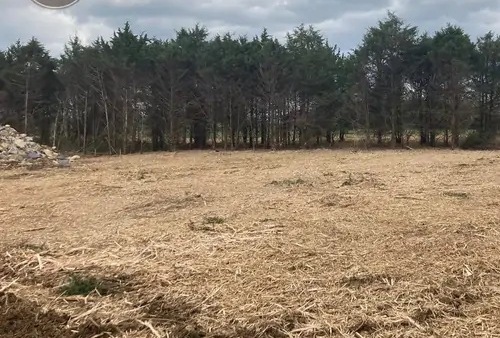
After forestry mulching
Forestry mulching usually leaves stumps at ground level and the roots in the soil, under a layer of mulch. Hardwood stumps left that way can sprout again. One landowner on the Permies forum watched cut beech and maple stumps come back as thick bushes.
After land clearing
Land clearing takes the stumps to ground level, below grade, or out entirely, and your quote names which. The less stump left in the soil, the less there is to sprout. The cut material is mulched in place, piled, or hauled away.
After brush hogging
Brush hogging cuts the stems and leaves every stump and root where it was. Woody brush grows back from them, which is why brush hogging is the job you repeat to keep cleared ground open.
Cedar is the exception
Eastern redcedar doesn't sprout from its stump. University of Nebraska Extension puts it plainly: trees cut below the lowest branches will not regrow. That's why cedar cleared from pasture edges and fence rows stays gone once it's cut low.

Arkansas rules that touch each job
On the first visit we tell you which Arkansas rules may touch your job and who handles each. Three come up most, and which one applies depends on what the work does to the soil and the water. The rules and permits guide goes through each in more depth.
Burn bans
They touch any job that leaves cut material piled. County judges declare burn bans county by county, and the Arkansas Department of Agriculture shows every county on its Wildfire Danger and Burn Ban Map. Owners who plan an open fire for their own brush piles check that map first. Forestry mulching leaves the cut material on the ground as mulch, so there's no pile.Source: Arkansas Department of Agriculture, Wildfire Danger and Burn Ban MapStormwater
It touches clearing and grading that's part of construction. The Arkansas Division of Environmental Quality's construction stormwater permit, ARR150000, covers construction that disturbs 1 acre or more. Sites of 1 to under 5 acres get automatic coverage but must post the required documents on site before work starts. At 5 acres or more, a Notice of Intent goes in through DEQ's online system.Source: Arkansas DEQ, Construction Stormwater Permits page, renewal effective November 1, 2026Wetlands
They touch machine work on ground that holds water. The U.S. Army Corps of Engineers, Little Rock District, states that clearing wetlands with mechanized equipment requires a permit under Section 404 of the Clean Water Act. That applies to a mulcher as much as a dozer, so a wet bottom gets checked with the Corps before the work starts.Source: U.S. Army Corps of Engineers, Little Rock District, Regulatory Division, jurisdictional determination letters