
Site prep and dirt work
- The work
- Getting one spot ready: a pad, a driveway, or a gravel road
- Leaves you
- Ground ready for the slab, the shop, or the trucks
- Rain
- Runs off the pad and to the edges of the road
- Fits
- A new house, shop, barn, or way in

Mark's Arkansas Land Clearing Service does site preparation and dirt work: house pads, driveways, gravel roads, and erosion control, statewide from three Google listings, rated 5.0 on Google.
A short recording answers first. Press 1 and you're put through.
We read the 1-to-3-star Google reviews of 88 Arkansas clearing and tree companies, and 172 of them were about the work itself. A pad built the wrong size, a yard left rutted, a start date that kept slipping: each question below answers one of those, with a promise the person running your job carries out.
17 of 172 reviews: the work didn't match what was agreed
Before the machine starts, we walk and flag the boundaries and anything you want saved, or send you photos of them.
12 of 172 reviews: the price changed with nothing in writing
You get a written quote before any work. It lists every charge, travel included. The price changes only if you approve the change in writing first.
9 of 172 reviews: ruts and a torn-up yard after the machines
If the ground is too wet to work without rutting, we tell you and reschedule. Any ruts we make are smoothed before we leave.
15 of 172 reviews: no firm date, only "next week"
Your quote comes with a start week. If the weather moves it, we call you.
61 of 172 reviews: the crew stopped answering
Every call or text gets a call back the same working day, from the person running your job.
0 of 172 reviews, yet Google is asked it for clearing, grading, and driveways
On the first visit we tell you which Arkansas rules may touch your job (burn bans, the 1-acre stormwater permit, septic permits) and who handles each.
What Arkansas landowners ask Google before a driveway or a pad goes in. Each answer starts with the answer.
You can, but it ruts fast if rain sits on it. The Federal Highway Administration's gravel roads guide says water left on a gravel surface softens it and leads to ruts, so the drive needs a crown that sheds water. Mark's Arkansas Land Clearing Service builds gravel roads and driveways across Arkansas.
Sometimes, depending on the road it meets. A driveway onto a state highway needs an access driveway permit from the ArDOT district's Permit Officer, and counties and cities set their own rules for their roads. On the first visit, Mark's Arkansas Land Clearing Service tells you which Arkansas rules may touch your job and who handles each.
Upkeep. The Federal Highway Administration's gravel roads guide names potholes, ruts, and washboarding as the usual problems, and says washboarding comes mostly from the gravel itself, not the grader. Mark's Arkansas Land Clearing Service builds gravel roads and driveways, and your written quote lists every charge, travel included.
We do, for any ruts we make. If the ground is too wet to work without rutting, Mark's Arkansas Land Clearing Service tells you and reschedules. Any ruts we make are smoothed before we leave, and if we damage anything, we tell you that day and put the fix in writing.

Mark's Arkansas Land Clearing Service is fully licensed and insured. We carry liability insurance and send the certificate on request.
We have the equipment for any land clearing or earth-moving job, so the trees come off, the pad goes in, and the drive gets built by the same crew. The estimate is free, and our lines are open 24/7.
We work statewide from three Google listings: Hindsville, Greenbrier, and Hot Springs. The crew comes to your land.
Six steps, in order, and what you see at each one.
Every call or text gets a call back the same working day, from the person running your job. If we can't take your job, we say so on the first call.
You show us where the house, the shop, or the drive will go. Before we quote, we tell you what the ground will look like the day we leave.
You get a written quote before any work. It lists every charge, travel included. Your quote comes with a start week.
We call the day before, and again when the crew pulls in. Before the machine starts, we walk and flag the boundaries and anything you want saved.
If the ground is too wet to work without rutting, we tell you and reschedule. Any ruts we make are smoothed before we leave.
We walk the site with you before we call the job done. Final payment is due after the walkthrough. Every payment gets a receipt.
Site preparation, site work, dirt work, excavating: it all means getting the ground ready to build on. These are the five kinds of site prep we do in Arkansas.
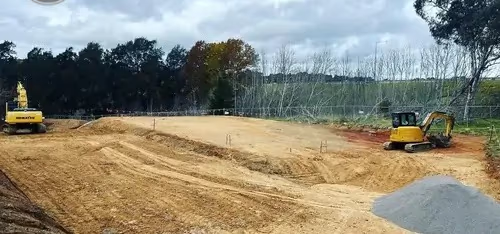
The spot where the house will sit, cleared and shaped so rain runs away from it. Its size and corners are flagged with you before the machine starts.

A way in from the road to the house, the shop, or the back gate, cleared, shaped, and topped with gravel. How a gravel drive holds up is in gravel roads, below.

Level ground for a shop, a barn, or an equipment shed, with room to turn a truck and trailer.

Digging, moving dirt from the high spots to the low ones, and hauling it in or out. A septic system is its own job: septic installation.

Trees, brush, and stumps come off before any dirt work starts. That part is land clearing.

We build gravel roads and driveways across Arkansas, from a short drive up to a house to a long road back to a barn or a hunting camp.
Water is what ruins a gravel road. The Federal Highway Administration's gravel roads guide says water that sits on the surface softens it and leads to ruts that can reach the dirt underneath. A road that lasts needs a crown, the right gravel, and somewhere for the rain to go.
Site work leaves bare dirt, and a hard rain can carry it off the pad, down the drive, and into the ditch. Erosion control is the work that holds it in place. The EPA's list of practices for construction sites splits that work in two.
Erosion controls keep the dirt from moving in the first place: mulching, permanent seeding, sodding, and matting on bare ground and slopes.
Sediment controls stop the dirt that does move before it leaves your land: silt fences, straw bales, fiber rolls, and sediment traps.
On a site that disturbs 1 acre or more, Arkansas's construction stormwater permit asks for a written plan for these controls, as the rules below explain.Source: U.S. EPA, National Menu of Best Management Practices for construction stormwater.
All three move dirt, and people mix them up. Here is what each one does and what it leaves you with.
Site prep leaves ground the next trade can build on and trucks can drive. Three things decide how it looks, and each is settled with you before the machine starts.
Before we quote, we tell you what the ground will look like the day we leave and what it will need afterwards to keep the brush from coming back.
If we have to leave before the job is finished, you get the return date before the crew leaves.
Every review on our three Google listings is five stars.
We had hired them to do some forestry mulching around Conway. They did a superb job and the crew completed the job on time. Thank you!
Mark and his team are outstanding! They were quick to get back with us, and did an excellent job.
A great job they did on my farm.
I will recommend it to everyone and my family
On the first visit we tell you which Arkansas rules may touch your job (burn bans, the 1-acre stormwater permit, septic permits) and who handles each.
Each region page lists its towns and the line nearest you. All three of our lines reach the same crew.
Benton, Washington, Madison, and Carroll counties
Pulaski, Faulkner, Saline, Lonoke, Perry, Conway, and Grant counties
Crawford, Sebastian, Franklin, Logan, Johnson, Scott, Pope, and Yell counties
Boone, Marion, Newton, Searcy, Baxter, Stone, Izard, Fulton, Sharp, Van Buren, and Cleburne counties
Garland, Montgomery, Hot Spring, Clark, Pike, and Polk counties
Randolph, Lawrence, Clay, Greene, Craighead, Mississippi, and Poinsett counties
Independence, Jackson, White, and Woodruff counties
Crittenden, Cross, St. Francis, Lee, Phillips, Monroe, Prairie, and Arkansas counties
Miller, Hempstead, Little River, Sevier, Howard, Lafayette, and Nevada counties
Union, Columbia, Ouachita, Calhoun, Dallas, Bradley, and Cleveland counties
Jefferson, Lincoln, Drew, Ashley, Chicot, and Desha counties
Every Arkansas town with its own page, and the line nearest each one
The rest of what landowners ask before the first load of gravel arrives.
Read the guidesCrushed stone blended with sand and fines. The federal gravel roads guide says good surface gravel uses fractured stone and fine particles that bind into a crust, while base gravel or sandy fill stays loose on top. Mark's Arkansas Land Clearing Service builds gravel roads and driveways across Arkansas.
For one layer of 1-inch stone, 2 inches is the minimum. The federal gravel roads guide says each layer should be at least twice as thick as its largest stone. What the whole drive needs depends on the ground under it and the trucks on it, so Mark's Arkansas Land Clearing Service walks the site before quoting.
Some gravel does, and that kind belongs under a building, not on top of a road. The federal gravel roads guide says sandy fill drains fast but stays loose on a road, while surface gravel needs binding fines and a crown to shed water. Mark's Arkansas Land Clearing Service builds gravel roads and driveways statewide.
Not always. In a mapped Special Flood Hazard Area, a floodplain development permit comes before any filling, grading, or excavation, and counties and cities set their own building rules. On the first visit, Mark's Arkansas Land Clearing Service tells you which Arkansas rules may touch your job and who handles each.
A short recording answers first. Press 1 and you're put through.