(479) 304-0400
Yellow backhoe digging a trench beside a green farm gate, a long pile of fresh dirt in front

Septic system installation site work in Arkansas

Mark's Arkansas Land Clearing Service clears septic sites and digs the soil pits, tank hole, and trenches to your approved design, statewide from three Google listings, rated 5.0 on Google.

A short recording answers first. Press 1 and you're put through.

Ask any septic excavation contractor these six questions

A septic job has three parties: the Arkansas Department of Health, which issues the permit; a Designated Representative it certifies, who tests the soil and draws the design; and a registered installer who builds the system. Our part is the ground work around it. We read 172 low-star Google reviews about the work of Arkansas clearing, tree, and dirt-work companies, and five of these questions come from what went wrong most often there.

  1. 01

    Who handles the septic permit?

    0 of 172 reviews, but landowners ask Google who files what

    On the first visit we tell you which Arkansas rules may touch your job (burn bans, the 1-acre stormwater permit, septic permits) and who handles each.

  2. 02

    Will the price stay what you quoted?

    12 of 172 reviews: the price went up with nothing in writing

    You get a written quote before any work. It lists every charge, travel included. The price changes only if you approve the change in writing first.

  3. 03

    What if you dig into a line?

    21 of 172 reviews: damage the crew wouldn't own

    If we damage anything (a fence, a gate, a line, a culvert), we tell you before we leave that day, and the fix goes in writing.

  4. 04

    What week do you start digging?

    15 of 172 reviews: never a firm date

    Your quote comes with a start week. If the weather moves it, we call you.

  5. 05

    Will somebody call me back?

    61 of 172 reviews: calls and texts went unanswered

    Every call or text gets a call back the same working day, from the person running your job.

  6. 06

    What if the site isn't ready when you leave?

    16 of 172 reviews: the job left half done

    If we have to leave before the job is finished, you get the return date before the crew leaves.

Quick answers about septic systems in Arkansas

What Arkansas landowners ask Google before a septic system goes in, answered from the Arkansas Department of Health's own rules.

Can I put in my own septic system in Arkansas?

Not on your own, in most cases. A Designated Representative certified by the Arkansas Department of Health completes the Permit for Construction, and the Department's rules put a registered installer on the job site during every phase of building the system. Mark's Arkansas Land Clearing Service does the clearing and digging around that work.

How far from a house should a septic tank be placed?

At least 10 feet. The Arkansas Department of Health's rules keep every part of a septic system at least 10 feet from any building and from property lines, and 100 feet from a water well. Mark's Arkansas Land Clearing Service digs to the layout on your approved permit.

How much does it cost to have a septic tank put in in Arkansas?

It depends on your soil and the approved design, so nobody can price it honestly over the phone. For the clearing and digging, Mark's Arkansas Land Clearing Service gives you a written quote before any work. It lists every charge, travel included.

How many bedrooms will a 1000 gallon septic tank support?

Up to three. The Arkansas Department of Health's minimum tank sizes call for 1,000 gallons for a home with one, two, or three bedrooms, plus 250 gallons for each bedroom past that. Mark's Arkansas Land Clearing Service digs the tank hole to the size on your permit.

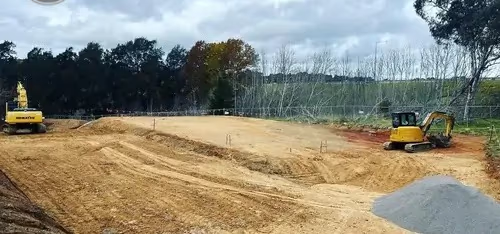
Two excavators at the edges of a freshly graded dirt pad, a pile of gravel in front
Frame 02Dirt workArkansas

Over 20 years on Arkansas land

Mark's Arkansas Land Clearing Service is fully licensed and insured. We carry liability insurance and send the certificate on request.

We have the equipment for any land clearing or earth-moving job, so the trees come off the septic site and the digging gets done by the same outfit. The estimate is free, and our lines are open 24/7.

Designated Representatives and septic installers carry their own Arkansas Department of Health credentials, and the Department keeps a public list of both. We work statewide from three Google listings: Hindsville, Greenbrier, and Hot Springs.

How the septic site work goes, from the call to the walkthrough

Six steps, and what you see at each one.

  1. 01

    A call back the same day

    Every call or text gets a call back the same working day, from the person running your job. If we can't take your job, we say so on the first call.

  2. 02

    We look at the site with you

    You show us where the house, the well, and the system will sit, with the design if your Designated Representative has drawn one. Before we quote, we tell you what the ground will look like the day we leave.

  3. 03

    Your quote, in writing

    You get a written quote before any work. It lists every charge, travel included. Your quote comes with a start week.

  4. 04

    Two calls, then the flags go in

    We call the day before, and again when the crew pulls in. Before the machine starts, we walk and flag the boundaries and anything you want saved.

  5. 05

    The digging

    The tank hole and trenches follow the approved design, since the rules allow no change to it without the health unit's approval. If the ground is too wet to work without rutting, we tell you and reschedule. Any ruts we make are smoothed before we leave.

  6. 06

    Walkthrough, then payment

    We walk the site with you before we call the job done. Final payment is due after the walkthrough. Every payment gets a receipt.

Septic site clearing, soil pits, and trench digging

The ground work on a septic job comes in five parts, in about the order they happen.

  • Old crawler dozer pushing dirt on a lot being cleared of brush and small trees

    Clearing the system site

    Trees, brush, and stumps come off the tank and field area and the path a truck takes to reach it. Clearing the rest of the lot is land clearing.

  • Yellow wheeled excavator digging along the edge of a flat field, fresh dirt piled beside it

    Digging the tank hole

    The hole goes where the approved permit puts it and as big as the tank it names. A home tank is never under 1,000 gallons, so the hole is the biggest single dig on the job.

  • Square hole dug straight down into dry, rocky soil

    Soil pits for your designer

    The rules ask for at least two soil pits, about 4 feet deep, one in the main absorption area and one in the backup area. They stay open for the inspector.

  • Pipe laid on a gravel bed in a freshly dug red dirt trench

    Absorption field trenches

    A standard pipe-and-gravel trench is 24 inches wide and 18 inches deep, with at least 6 feet of undisturbed ground between trenches.

  • Operator in a skid steer carrying broken slabs across a dirt work site

    Backfill and the final grade

    Dirt goes back over the tank and trenches when the installer is ready for it, and the yard is graded smooth. Bigger leveling jobs are grading and land leveling.

Septic site work, site prep, or drainage work

All three are dirt work, and landowners often need two of them on one property. Here's what each one digs, what it leaves, and who signs off.

Septic site work

Digs
Soil pits, the tank hole, and the absorption trenches
Leaves behind
A buried system under backfilled, graded ground
Signs off
The health unit inspects it before the Permit for Operation
Fits
A house, cabin, or shop on land with no sewer line

Site prep and dirtwork

Digs
Dirt for a house pad, a shop pad, or a gravel road
Leaves behind
Level ground ready to build on or drive
Signs off
You, at the walkthrough
Fits
Ground about to be built on
Site prep and dirtwork

Drainage solutions

Digs
Ditches and drain lines that carry water away
Leaves behind
Ground where the water goes where you want it
Signs off
You, at the walkthrough
Fits
Standing water, a soggy yard, or a washout
Drainage solutions

What the ground over a septic system looks like the day we leave

Once the system is covered, most of it is out of sight. Three things are worth knowing about what sits under your yard.

Drawn cross-section of a septic system: a house at left, a pipe running to a buried tank, three absorption trenches in natural soil, and smooth finished ground over all of it 1 2 3
  1. 1The tankSized by bedrooms on your permit and set where the design puts it, well clear of the house.
  2. 2The absorption fieldAt least two trenches, side by side in natural soil. The rules allow no field in fill dirt.
  3. 3Finished groundBackfilled and graded smooth, soil pits included, after the inspector has seen them.
Before we quote

Before we quote, we tell you what the ground will look like the day we leave and what it will need afterwards to keep the brush from coming back.

Stumps on the site

Your quote says how the stumps will be left (ground level, below grade, or removed). We check it with you at the walkthrough.

5.0on Google

What landowners say after the work

These reviews come from clearing and mulching jobs. Every review on our three Google listings is five stars.

We had hired them to do some forestry mulching around Conway. They did a superb job and the crew completed the job on time. Thank you!

Rashel Reece Liu, Google review
  • Mark and his team are outstanding! They were quick to get back with us, and did an excellent job.

    Noela May Tiansay
  • A great job they did on my farm.

    Erin Mitchell
  • I will recommend it to everyone and my family

    Mariz Morada

Arkansas septic rules, and who handles each one

On the first visit we tell you which Arkansas rules may touch your job (burn bans, the 1-acre stormwater permit, septic permits) and who handles each. These three come from the Arkansas Department of Health and touch every septic job.

  1. The permit

    Part I of the septic permit is the Permit for Construction. A Designated Representative certified by the Department fills it out with the soil results and the system design, and the Department or its local health unit approves it before construction starts. It's good for one year, and nobody may start building a system for an owner who doesn't hold one.Source: Arkansas Department of Health, Rules Pertaining to Onsite Wastewater Systems (effective September 5, 2024), Sections 2.67, 4.5, and 4.10.1
  2. The installer and the inspection

    A registered installer is on the job site during every phase of building the system and gives the health unit 24 hours' notice before work starts. The health unit inspects the installation, and nobody uses the system until the Permit for Operation is issued.Source: Arkansas Department of Health, Rules Pertaining to Onsite Wastewater Systems, Sections 4.6, 4.7, 4.10.3, and 14.1
  3. Setbacks and the 10-acre exemption

    Every part of the system sits at least 100 feet from a water well, a stream, or a lake, and 50 feet from a pond on the same property. A single home on 10 acres or more may be exempt from the permit when every part of the system is more than 200 feet from any property line, though it still has to meet the Department's standards.Source: Arkansas Department of Health, Rules Pertaining to Onsite Wastewater Systems, Section 6.2; Onsite Wastewater FAQs

Septic site work near you, region by region

Each region page lists its towns and the line nearest you. Every line reaches the same crew.

Northwest Arkansas

Benton, Washington, Madison, and Carroll counties

Central Arkansas

Pulaski, Faulkner, Saline, Lonoke, Perry, Conway, and Grant counties

Arkansas River Valley

Crawford, Sebastian, Franklin, Logan, Johnson, Scott, Pope, and Yell counties

Ozarks and North Central

Boone, Marion, Newton, Searcy, Baxter, Stone, Izard, Fulton, Sharp, Van Buren, and Cleburne counties

Hot Springs and the Ouachitas

Garland, Montgomery, Hot Spring, Clark, Pike, and Polk counties

Northeast Arkansas

Randolph, Lawrence, Clay, Greene, Craighead, Mississippi, and Poinsett counties

White River Valley

Independence, Jackson, White, and Woodruff counties

Arkansas Delta

Crittenden, Cross, St. Francis, Lee, Phillips, Monroe, Prairie, and Arkansas counties

Southwest Arkansas

Miller, Hempstead, Little River, Sevier, Howard, Lafayette, and Nevada counties

South Arkansas

Union, Columbia, Ouachita, Calhoun, Dallas, Bradley, and Cleveland counties

Southeast Arkansas

Jefferson, Lincoln, Drew, Ashley, Chicot, and Desha counties

Towns we serve, A to Z

Every Arkansas town with its own page, and the line nearest each one

More septic questions

Tank sizes, daily flow, and the smallest system the Arkansas rules allow.

Read the guides
Can a 4 bedroom house have a 1000 gallon septic tank?

No. Under the Arkansas Department of Health's minimums, a four-bedroom home needs at least a 1,250-gallon tank, because each bedroom past three adds 250 gallons. Your Designated Representative sizes the tank on the permit, and Mark's Arkansas Land Clearing Service digs to that size.

How many gallons a day can a septic system handle?

As many as it was designed for, and a home is designed by bedrooms. The Arkansas Department of Health's design flows are 370 gallons a day for three bedrooms and 450 for four, plus 50 for each bedroom after that. Mark's Arkansas Land Clearing Service builds the ground work to that design.

What is the smallest septic system you can put in?

For a home, a 1,000-gallon tank and two absorption trenches. Those are the Arkansas Department of Health's minimums, and the second trench keeps the field working if one is disturbed. Mark's Arkansas Land Clearing Service digs to the design on your permit, not to a guess.

Is there a septic system that doesn't need a leach field?

Not a holding tank, for a home. The Arkansas Department of Health's rules don't approve holding tanks for residences, full or part time. Where the soil won't take a standard trench field, your Designated Representative picks another approved design, and Mark's Arkansas Land Clearing Service does the dirt work for it.

Tell us where the septic system is going

(479) 304-0400
Call or text. The person running your job calls you back the same working day.

A short recording answers first. Press 1 and you're put through.

Call (479) 304-0400