(479) 304-0400
Concrete culvert under a farm crossing on a grassy drainage ditch beside a flat field

Land drainage, ditches, and culverts in Arkansas

Mark's Arkansas Land Clearing Service drains wet land: it digs drainage ditches, shapes swales, sets culverts, and fills low spots that hold water, statewide from three Google listings, rated 5.0 on Google.

A short recording answers first. Press 1 and you're put through.

Ask any drainage contractor these six questions

We read the 1-to-3-star Google reviews of 88 Arkansas clearing, tree, and dirt-work companies, and 172 of them were about the work itself. Water that still stood, ruts, a broken culvert, a price that grew, and a phone nobody answered all came up. Each answer here is a promise the person running your job carries out.

  1. 01

    Will the water still stand after you leave?

    2 of 172 reviews: the drainage was worse after the work

    Before we quote, we tell you what the ground will look like the day we leave. We walk the site with you before we call the job done.

  2. 02

    What if the ground is too wet to work?

    9 of 172 reviews: ruts and a torn-up yard after the machines

    If the ground is too wet to work without rutting, we tell you and reschedule. Any ruts we make are smoothed before we leave.

  3. 03

    What if a culvert or a line gets hit?

    21 of 172 reviews: damage the crew wouldn't own

    If we damage anything (a fence, a gate, a line, a culvert), we tell you before we leave that day, and the fix goes in writing.

  4. 04

    Will the price change once the digging starts?

    12 of 172 reviews: the price changed with nothing in writing

    You get a written quote before any work. It lists every charge, travel included. The price changes only if you approve the change in writing first.

  5. 05

    What happens when rain moves the start?

    15 of 172 reviews: no firm date, only "next week"

    Your quote comes with a start week. If the weather moves it, we call you.

  6. 06

    Who calls me back?

    61 of 172 reviews: the crew stopped answering

    Every call or text gets a call back the same working day, from the person running your job.

Quick answers about yard and land drainage

What Arkansas landowners ask Google when water sits where it shouldn't. Each answer starts with the answer.

How to fix a yard with poor drainage?

Give the water a path off the yard. Find where it comes from and where it can leave, then grade the ground, cut a swale, or open a ditch to carry it there. Mark's Arkansas Land Clearing Service walks the wet ground with you first, and you get a written quote before any work.

How to drain wet spots in lawn?

Fill the low spot or give it an outlet. A shallow dip can be filled and graded so rain runs past it, and a wetter hollow needs a swale or a ditch to carry the water out. If the ground is too wet to work without rutting, Mark's Arkansas Land Clearing Service tells you and reschedules.

How to make water go away from your house?

Grade the ground so it falls away from the foundation. The International Residential Code, section R401.3, asks for a fall of at least 6 inches in the first 10 feet, or a swale or drain where that slope won't fit. Mark's Arkansas Land Clearing Service does the grading and the swale work.

Do I need a permit to regrade my yard?

It depends on the size and the place. Arkansas's construction stormwater permit, ARR150000, starts at 1 acre disturbed, and grading in a mapped flood zone needs a floodplain development permit first. On the first visit, Mark's Arkansas Land Clearing Service tells you which rules may touch your job and who handles each.

Worker in a safety vest walking beside a yellow excavator at the edge of a flat field
Frame 02Earth movingArkansas

Over 20 years of work on Arkansas land

Mark's Arkansas Land Clearing Service is fully licensed and insured. We carry liability insurance and send the certificate on request.

We have the equipment for any land clearing or earth-moving job. Clearing a brushy ditch line, digging it out, and grading the ground that feeds it stays with one crew. The estimate is free, and our lines are open 24/7.

We work statewide from three Google listings: Hindsville, Greenbrier, and Hot Springs. The crew comes to your land.

How drainage work goes, from your call to the walkthrough

Six steps, in order, and what you see at each one.

  1. 01

    A person calls you back

    Every call or text gets a call back the same working day, from the person running your job. If we can't take your job, we say so on the first call.

  2. 02

    We walk the wet ground

    You show us where the water stands and where it runs in a hard rain. Before we quote, we tell you what the ground will look like the day we leave.

  3. 03

    A quote in writing

    You get a written quote before any work. It lists every charge, travel included. Your quote comes with a start week.

  4. 04

    Two calls, then flags

    We call the day before, and again when the crew pulls in. Before the machine starts, we walk and flag the boundaries and anything you want saved.

  5. 05

    The ditch and grade work

    If the ground is too wet to work without rutting, we tell you and reschedule. Any ruts we make are smoothed before we leave.

  6. 06

    Walkthrough, then payment

    We walk the site with you before we call the job done. Final payment is due after the walkthrough. Every payment gets a receipt.

Drainage ditches, swales, culverts, and low spots

Drainage on a lot or a pasture comes down to five kinds of dirt work, and we do all five on Arkansas land.

  • Rainwater standing in low spots across a grassy field

    Low spots that hold water

    A hollow that stays wet for days after a rain gets filled and graded so water runs past it, or gets an outlet to a swale or ditch. Reshaping a whole yard or field is grading and land leveling.

  • Yellow wheeled excavator beside a water-filled drainage ditch, with fresh spoil piled on the grass

    Drainage ditches

    New ditches cut along a field edge or a property line, and old ones dug back out where silt and brush have filled them in. A ditch line grown up in trees starts with land clearing.

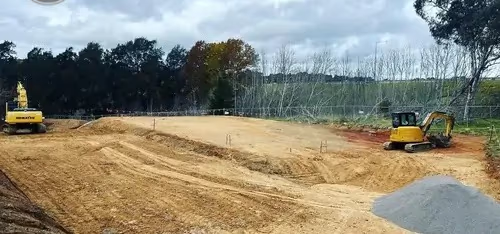
  • Graded dirt building pad with shaped slopes, two excavators, and a pile of gravel

    Swales around a house or shop

    A swale is a shallow, grassed channel. Shaped around a pad, it turns runoff aside before it reaches the building. The pad itself is site prep and dirtwork.

  • Corrugated metal culvert pipe pouring muddy runoff into a brushy ditch

    Culverts under drives

    A drive or a field crossing over a ditch needs a culvert so the water keeps moving under it. We set culverts for new drives and dig out both ends of one that silt has choked.

  • Motor grader reshaping a dirt road between brushy shoulders

    Roads and drives that wash out

    Water that runs down a gravel road instead of beside it cuts gullies. We shape the road and the ditches beside it so the water leaves the gravel. New roads are site prep and dirtwork.

Drainage work, grading, or site prep

All three move dirt, and a wet lot often needs more than one. Here is what each job works on and what it leaves behind.

Drainage work

Works on
The spots where water stands, runs, or crosses a drive
Leaves behind
Ditches, swales, culverts, and filled low spots
Water
The reason for the job: it gets a path off your land
Fits
A soggy yard, a wet pasture corner, or a drive that washes out

Grading and leveling

Works on
The shape of the whole surface
Leaves behind
Level or evenly sloped ground
Water
Sheds off the slope instead of pooling in bumps and dips
Fits
A bumpy yard, an uneven field, or a site before building
Grading and land leveling

Site prep and dirtwork

Works on
Ground for a house, a shop, or a road
Leaves behind
A building pad, a gravel road or drive, and erosion control
Water
Erosion control keeps soil from washing off the worked ground
Fits
Getting a cleared lot ready to build on
Site prep and dirtwork

What drained ground looks like the day we leave

Drainage work leaves ground that moves water off instead of holding it. Three parts decide how that looks on your land, and we go over each one on the first walk.

Drawn cross-section of drained land: ground graded to fall away from a house, a grassed swale catching the runoff, and a culvert under a gravel drive 1 2 3
  1. 1Ground that falls awayGraded so rain runs off the house site or the pad instead of pooling against it.
  2. 2A swale or a ditchA shaped channel that catches the runoff and carries it to where it can leave your land.
  3. 3Culvert under the driveA pipe under the gravel lets the ditch keep running where the drive crosses it.
If we have to leave

If we have to leave before the job is finished, you get the return date before the crew leaves.

If we can't make it

If we can't keep an appointment, we call you before it.

5.0on Google

What landowners say about the crew

Every review on our three Google listings is five stars.

We had hired them to do some forestry mulching around Conway. They did a superb job and the crew completed the job on time. Thank you!

Rashel Reece Liu, Google review
  • They were quick to get back with us, and did an excellent job.

    Noela May Tiansay
  • A great job they did on my farm.

    Erin Mitchell
  • I will recommend it to everyone and my family

    Mariz Morada

Arkansas rules that touch moving water on your land

On the first visit we tell you which Arkansas rules may touch your job (burn bans, the 1-acre stormwater permit, septic permits) and who handles each.

  1. Stormwater

    The Arkansas Division of Environmental Quality's construction stormwater permit, ARR150000, covers construction that disturbs 1 acre or more. Sites of 1 to under 5 acres are covered automatically. At 5 acres or more, a Notice of Intent goes in at least 10 business days before work starts.Source: Arkansas DEQ, ARR150000 fact sheet, permit effective November 1, 2026
  2. Flood zones and wetlands

    In a mapped flood hazard area, filling, grading, or digging needs a floodplain development permit from the city or county before work begins, and a floodway needs an engineering analysis first. Filling a wetland or cutting a new ditch through one can need a federal Section 404 permit. Maintenance of an existing drainage ditch is exempt; construction of a new one is not.Sources: Arkansas Department of Agriculture, Natural Resources Division, Floodplain Management FAQ; US EPA, Exemptions to Permit Requirements under CWA Section 404
  3. A neighbor's land

    Arkansas courts let you defend your land against surface runoff, but not by damaging a neighbor when reasonable effort and expense would have avoided it. Water in a defined channel with a bed and banks is a watercourse, and you can't block it. A new ditch or swale should send water where it already runs, not onto the next property.Source: Arkansas Court of Appeals, Boyd v. Greene County, 7 Ark. App. 110 (1983)

Drainage work near you, region by region

Each region page lists its towns and the line nearest you. All three of our lines reach the same crew.

Northwest Arkansas

Benton, Washington, Madison, and Carroll counties

Central Arkansas

Pulaski, Faulkner, Saline, Lonoke, Perry, Conway, and Grant counties

Arkansas River Valley

Crawford, Sebastian, Franklin, Logan, Johnson, Scott, Pope, and Yell counties

Ozarks and North Central

Boone, Marion, Newton, Searcy, Baxter, Stone, Izard, Fulton, Sharp, Van Buren, and Cleburne counties

Hot Springs and the Ouachitas

Garland, Montgomery, Hot Spring, Clark, Pike, and Polk counties

Northeast Arkansas

Randolph, Lawrence, Clay, Greene, Craighead, Mississippi, and Poinsett counties

White River Valley

Independence, Jackson, White, and Woodruff counties

Arkansas Delta

Crittenden, Cross, St. Francis, Lee, Phillips, Monroe, Prairie, and Arkansas counties

Southwest Arkansas

Miller, Hempstead, Little River, Sevier, Howard, Lafayette, and Nevada counties

South Arkansas

Union, Columbia, Ouachita, Calhoun, Dallas, Bradley, and Cleveland counties

Southeast Arkansas

Jefferson, Lincoln, Drew, Ashley, Chicot, and Desha counties

Towns we serve, A to Z

Every Arkansas town with its own page, and the line nearest each one

More drainage questions

The rest of what landowners ask before the first ditch gets dug.

Read the guides
What are the different types of yard drains?

There are surface drains and underground drains. Surface drains are graded slopes, swales, ditches, and culverts that move water across the top of the ground. Underground drains include French drains, drain tile, and dry wells. Mark's Arkansas Land Clearing Service does the surface earthwork.

What is an alternative to a French drain?

Surface drainage is the main alternative: regrade the ground so it sheds water, or cut a swale that carries the water off before it soaks in. Both are dirt work, and Mark's Arkansas Land Clearing Service has the equipment for any land clearing or earth-moving job.

What time of year to regrade a yard?

Whenever the ground is dry enough to work without rutting. Mark's Arkansas Land Clearing Service checks the ground before the machine starts. If it's too wet, we tell you and reschedule, and any ruts we make are smoothed before we leave.

Do landscapers regrade yards?

Some do, and so do dirt-work crews with grading equipment. Mark's Arkansas Land Clearing Service grades yards, lots, and pasture, and carries the job on into ditches, swales, and culverts when the water needs somewhere to go. Your quote comes with a start week.

Tell us where the water stands on your land

(479) 304-0400
Call or text. The person running your job calls back the same working day.

A short recording answers first. Press 1 and you're put through.

Call (479) 304-0400